
A data broker (also known as an information product company) is an organization that makes money by collecting your personal information, analyzing it, and licensing it out to be used by other companies for things like marketing purposes.
Data providers gather data from many different sources to create a profile of who you are. This profile includes things like your interests, hobbies, demographics, and even the products you use.
Generally, data broker companies only deal with customers to collect information. A few of the top data brokerage companies are Epsilon, Acxiom, and Experian, but there are many data brokerages worldwide that make a hefty profit from aggregating and distributing consumers’ personal data.
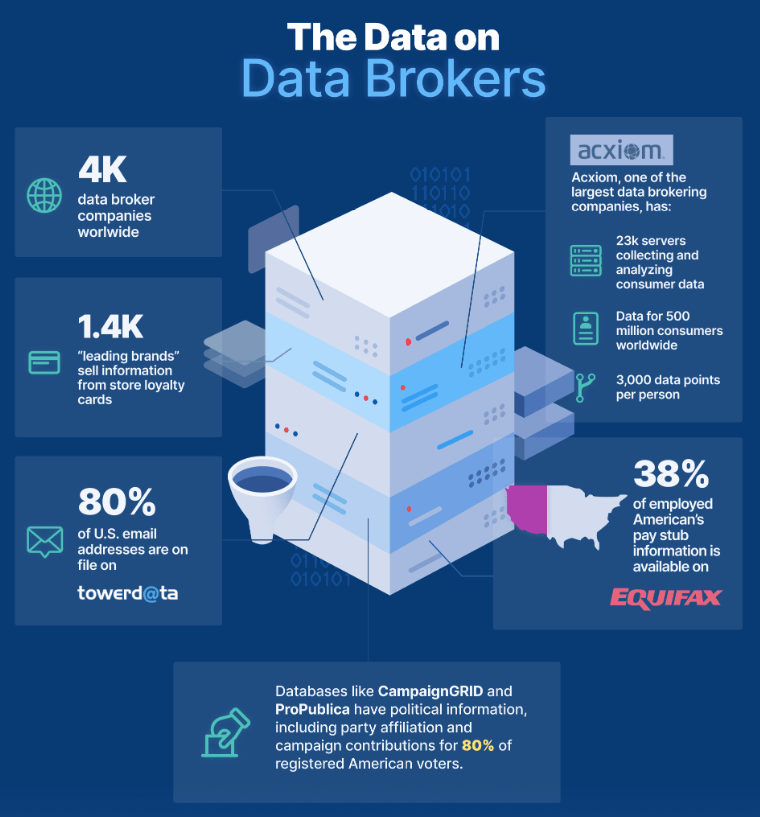
Today, there are over 4,000 data brokering companies worldwide. Acxiom, one of the largest, has 23,000 servers collecting & analyzing consumer data, Data for 500 million consumers worldwide, and up to 3,000 data points per person – and that’s just one company.
But where do they get this information? Over 1,400 “leading brands” sell information from store loyalty cards to data brokers, meaning that if you’ve ever signed up for a loyalty or store credit card at one of your favorite stores, there’s a good chance the data you provided was sold to a broker. Depending on the store you signed up at, you could be added to a variety of different databases.
For example, if you signed up for a loyalty card at a pet store, your information might be sold to companies looking to market to pet owners. Although it is a relatively new industry, data brokers already have information for a pretty sizable amount of the population. In fact, 80% of U.S. email addresses are on file on Towerdata, and 38% of employed Americans’ pay stub information is available on Equifax. In addition, databases like CampaignGrid and ProPublica have political information including party affiliation and campaign contributions for 80% of registered American voters. It’s pretty safe to assume that at least some of your data is on file with brokers.
Want to opt-out from having your data collected?
Personal data deletion services: Helpful, but not a cure-all
So, what can you do about it? You can contact these brokers and request they delete your information from their systems. However, it can be difficult to find the opt-out forms, and you have to provide various forms of identification proving the information you are requesting them to delete is your information. The process can also take anywhere from a few days to weeks to complete. Personal data deletion services offer a way to expedite the process.
Personal data deletion services go by a lot of different names, including personal information removal services, privacy information removal services and data removal services, and include services like Incogni, Privacy Bee and DeleteMe. However, their services cover on a fraction of data brokers.
Some data brokers don’t allow third parties to request information be deleted on a person’s behalf, either, according to McAfee. That means you have to request these data brokers delete your information yourself — a personal data deletion service can’t do it.
There is also no way to check if data brokers comply with these requests to delete your information. Personal data deletion services, to their credit, say as much on their websites.
Opt-Out DIY
This site; Incogni lists several different Data Brokers and how to remove your data. Here are some of the biggest data brokers you can contact to opt-out of having your data collected:
- 411.info – allows full opt-out
- Acxiom – allows partial opt-out
- CoreLogic – allows full opt-out
- DataLogix – allows full opt-out
- eBureau – allows full opt-out
- Epsilon – allows full opt-out
- FICO – allows partial opt-out
- Harte Hanks – allows full opt-out
- infoUSA – allows full opt-out
- Instant Checkmate – allows full opt-out
- Intelius – allows full opt-out
- LexisNexis – allows full opt-out
Privacy Scan
Experian offers a one-time free personal privacy scan.
Here are some tips for blocking data collection while browsing the web:
- Use a virtual private network (VPN) to encrypt your internet traffic and hide your IP address: A VPN is a service that provides a layer of protection between you and vulnerable Wi-Fi networks, internet service providers (ISPs), the sites and apps you browse, and other parties that enable your experience but may lack adequate security.
- Opt for a privacy-focused browser like DuckDuckGo or Brave: Both browsers block third-party tracking and do not share or store personal data by default.
- Install browser add-ons and extensions to block trackers and other unwanted content: If you don’t want to switch browsers entirely, you can use extensions such as those offered by Privacy Badger, DuckDuckGo, Privacy Essentials, or Ghostery to protect you.
- Use private browsing mode and disable third-party cookies: Cookies may promote a quicker browsing experience but they track and store your browser information, which can be risky.
- Use a secure search engine such as DuckDuckGo, Startpage, or Qwant: Popular search engines may store, track, or even sell your information, including but not limited to your location and search data. Privacy-focused search engines typically don’t log user activity and include the infrastructure to block web tracking.
- Use Do Not Track (DNT) requests in your browser settings: A DNT will signal to the websites you visit that you don’t want their tracking cookies. However, a caveat is that the sites you visit can choose to ignore your requests.
- Regularly clear your browsing history and cache: Your history stores information about the sites you’ve visited, the files you’ve downloaded, and active login sessions.
- Use Privacy Virtual Cards to shop anonymously online: Some merchants sell or use their customer’s data for other purposes. Generating an instant card number adds a layer of protection between you and the merchant.